
Tempris LyoCLC® – Prediction of the Endpoint of Primary Drying
Optimize and Accelerate Freeze-drying Processes
Lyophilization has become indispensable in the production of many pharmaceutical products. It offers numerous advantages: high product stability, extended shelf life, and improved storability. At the same time, it is a sensitive and cost-intensive process that places high demands on process design – particularly regarding the prediction of the endpoint of primary drying.
This endpoint is a critical factor in freeze-drying – it has a significant impact on product quality, cycle time, and regulatory acceptance. In practice, this critical point could previously only be estimated. The result: uncertainty, prolonged drying times, and wide safety margins.
With LyoCLC®, Tempris has succeeded in enabling the scientifically validated prediction of the endpoint of primary drying – ensuring consistent product quality and improved cost-efficiency.
What is LyoCLC® and how does it enable the prediction of the endpoint of primary drying in pharmaceutical freeze-drying?
LyoCLC®, short for “Closed Loop Control,” is an innovative, scientifically based method for the objective prediction of the endpoint of primary drying. After a targeted temperature increase, the product-temperature profile is analyzed, logarithmically transformed, and evaluated using linear regression. Based on this analysis, LyoCLC® supports the reproducible and automatable prediction of the endpoint of primary drying. The suitability, accuracy, and domain of applicability of the method must be confirmed for the intended product, vial, process, and equipment context.
Advantages of the LyoCLC® method for freeze-drying
- Reproducible
- Validatable
- Can be qualified for the intended use within the applicable product, vial, process, and equipment context
LyoCLC® supports data-driven decisions and can narrow the experimental search space. Once validated for its intended use, subsequent confirmation runs can be planned more selectively and their scope reduced on a risk-based basis. LyoCLC® thereby provides a foundation for more efficient and traceable process evaluation.
How does LyoCLC® work in lyophilization?
In combination with Tempris sensors, the LyoCLC® software uses real-time data and machine learning to accurately predict the endpoint of primary drying. This transforms the freeze-drying process from a static procedure into a dynamic, interactive operation – with the ability to intervene precisely in real time.

A practical example:
During primary drying, LyoCLC® analyzes the product-temperature profiles measured at the instrumented vial positions. On this basis, the software supports position-specific, model-based assessments of Kᵥ and Rₚ. Results may be transferred to non-instrumented vial positions only within a model qualified for the intended use and its documented domain of applicability.
Conventional gravimetric Kᵥ characterization derives heat-transfer information from mass loss over a defined interval. Tempris adds continuous, position-specific product-temperature data under actual process conditions. The two approaches can complement each other. Any claim of higher accuracy than a reference method must be demonstrated experimentally for the specific application.
Based on the evaluated data, LyoCLC® can provide recommendations for further process assessment. Any changes to shelf temperature, chamber pressure, or process time are subject to expert review and approval by the user within the validated control strategy.
This creates full transparency over the actual heat input and provides a solid foundation for:
- Optimized process development
- Realistic design spaces
- Improved process control
- A reduced experimental search space and selectively planned confirmation runs
Why are LyoCLC® and the prediction of the endpoint of primary drying beneficial for pharmaceutical product approval?
Regulatory authorities such as the FDA frequently criticize the lack of sufficient documentation for the endpoint of primary drying in more than half of submitted dossiers. (Read more in the report “A Regulatory Perspective on Manufacturing Processes Pertaining to Lyophilized Injectable Products” by Steve Y. Rhieu, David D. Anderson, and Kumar Janoria).
LyoCLC® provides a solution:
The method for the prediction of the endpoint of primary drying is objective, scientifically validatable, and fully traceable. Combined with Tempris sensors, the system delivers comprehensive real-time data that can be easily documented and used for regulatory submissions and audits.
Thus, LyoCLC® not only contributes to efficiency and quality in pharmaceutical production – it also enhances safety and transparency in the approval process.
How Tempris and LyoCLC® Work
Sensor Placement
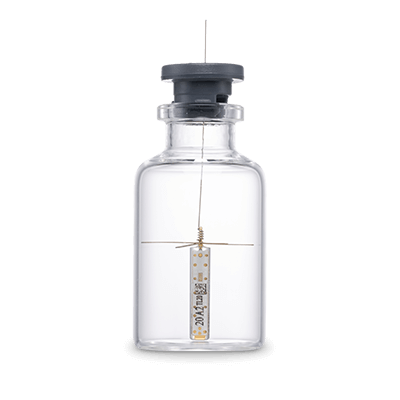
Figure 1 : Sensor in Vial

Figure 2: Manual sensor insertion with tweezers

Figure 3: Automatic sensor insertion by robot
Data Acquisition
Determining the measuring positions in the Lyo is crucial for process optimization. Keyword: variance. It is therefore necessary to know the critical positions (so-called Hot & Cold Spots = HCS) in a dynamic drying process. They are recorded and transmitted to the analysis software in real time during the cycle so that the first analysis results are already available during the cycle and intervention is possible if necessary. The determination of the HCS is recorded with the RF sensors and evaluated with the analysis software. As the parameters of each freeze-drying system differ, this work must be carried out carefully. Even identical freeze-drying systems can differ in their behavior and therefore performance. Keyword: CPPs

Figure 1: Screenshot of the TLM-3D Software with the digiatl twin
Analysis with LyoCLC®
The TLM-3D software visualizes the product temperature (TP) at the critical positions (HCS) and can display this as a histogram in variance groups using so-called bins of the LyoCLC® software.
With the LyoCLC®, the variance is recorded and the design space is correctly determined (not simulated) in real time using software, taking into account the system capacity and product properties. Thanks to the new algorithm for determining the control shelf temperature, the control shelf temperature under each individual vial can be determined separately at the first entry into the exponential phase at the end of primary drying.
Until now, it was common practice to consider the product and shelf temperature as the result of the simulation of the design space (determined using the Claudius-Clapeyron equation). With LyoCLC®, it is possible to include the temperatures as input values in the simulation and immediately determine the individual Kv values or Rp resistance values (resistance of the already dried parts in the vial to the vapor from sublimation), for example.

Figure 1: Screenshot of LyoCLC® software
Process Control
Determining the key status parameters, such as the residual moisture of the freeze-drying run, allows the control parameters to be calculated in real time as part of a closed loop control instead of the previous static definition. To ensure robust control, the derived statistical parameters are used to calculate the control parameters with good statistical certainty by means of statistical hypothesis tests. This means that even those vials that are not equipped with a temperature sensor are taken into account with a high degree of certainty. This dynamically guarantees an optimum drying result for all vials with economical use of the freeze-drying system.

Figure 1: Fixed process vs. variable process (source: FDA)
LyoCLC® – Prediction Endpoint of Primary Drying
Primary drying is a critical phase of the freeze-drying process, where frozen water is removed by sublimation. The Tempris technology enables real-time monitoring of the product temperature. The use of artificial intelligence in conjunction with machine learning (AI/ML) generates robust process data in real-time, taking into account both critical product properties and the reduction of inefficient process cycles.
In this context, linear regression can be used to predict the endpoint of primary drying by modeling the product temperature as the relevant process parameter over time. This provides a solid basis for decision-making that would otherwise require time-consuming and costly validation batches used for complex simulations.
The following describes the algorithm:


Conclusion: The algorithm can be applied to different freeze-dryers, formulations, vial sizes, and fill volumes. However, its suitability, accuracy, and domain of applicability must be confirmed for the specific application using appropriate reference data.
Optimized Freeze-Drying: Download the Scientific Paper Now!
How can product quality and process efficiency in freeze drying be significantly improved? Answers can be found in the scientific paper by Johanna Herzog, Anton Mangold, Oliver Bartels and Henning Gieseler, published at FAU Erlangen-Nuremberg: „Improved Product Quality in Freeze-Drying by Applying Live Statistics and Closed-Loop Control“. This paper was presented at the 5th European Conference of Pharmaceutics and Biopharmaceutics in Porto and demonstrates how innovative technologies such as Tempris Technology and the closed-loop algorithm are revolutionizing freeze-drying.

Abstract
This paper presents the newly developed closed-loop algorithm for process optimization in freeze-drying. The study investigates whether sensor-equipped vials exhibit the same drying behavior as non-equipped vials. To validate this, residual moisture was determined using Karl Fischer titration, and a statistical analysis (ANOVA test) was conducted. The results show that sensor measurements enable reliable process monitoring without affecting product quality. Implementing this approach can shorten drying time and improve process reproducibility.
Download the full paper now and discover the future of freeze-drying!