
LyoINSIGHT powered by LyoCLC®
From Product Temperature Data to Robust Process Understanding in Lyophilization
A cycle is too long, a laboratory process needs to be scaled up, a transfer needs to be prepared, or a production deviation needs to be assessed. Critical information is often scattered across multiple sources.
LyoINSIGHT powered by LyoCLC® combines LyoCONNECT product-temperature measurements at selected vial positions with process conditions, loading, and equipment context, and integrates them with the Tempris Digital Twin, model-based analysis, and expert consultation. This turns existing data into traceable process understanding and a project-specific, well-founded next verification step.
The Objective
Typical starting points
Which Process Question Would You Like to Start With?
LyoINSIGHT starts with the decision at hand, not with the broadest possible software implementation. The following starting points help define the project objective, required evidence, and the next verification step.
Expert Consultation
Start with the Process Question
LyoINSIGHT is a guided Tempris methodology. The responsible experts from the customer and Tempris first define the purpose of the decision, stakeholders, required evidence, roles, and data readiness. Only then are the measurement strategy and model-based analysis defined. This approach guards against partial application of the methodology and conclusions that are not supported by the available data.
LyoINSIGHT does not replace expertise. Its guided structure helps experienced specialists combine measurement data, models, and process knowledge more efficiently. Less experienced users gain a clear path to the critical relationships. Technical assessment and accountable decision-making remain with the responsible experts.
Tempris Evidence Architecture
What the Freeze-Dryer Applies – and What the Product Actually Endures
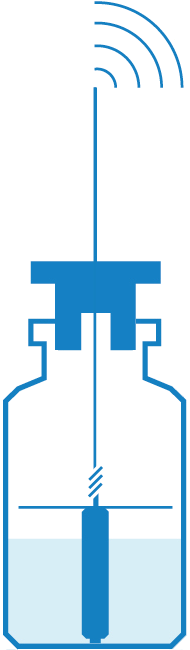
The equipment operates under specific process conditions. However, these conditions alone do not reveal the actual temperature inside each vial. LyoCONNECT uses wireless, battery-free sensors to directly monitor the product temperature Tp at selected vial positions. Consequently, the actual product response acts as the measurable reference for LyoINSIGHT.
How do we know the product temperature?

Bridge to the Evidence Architecture
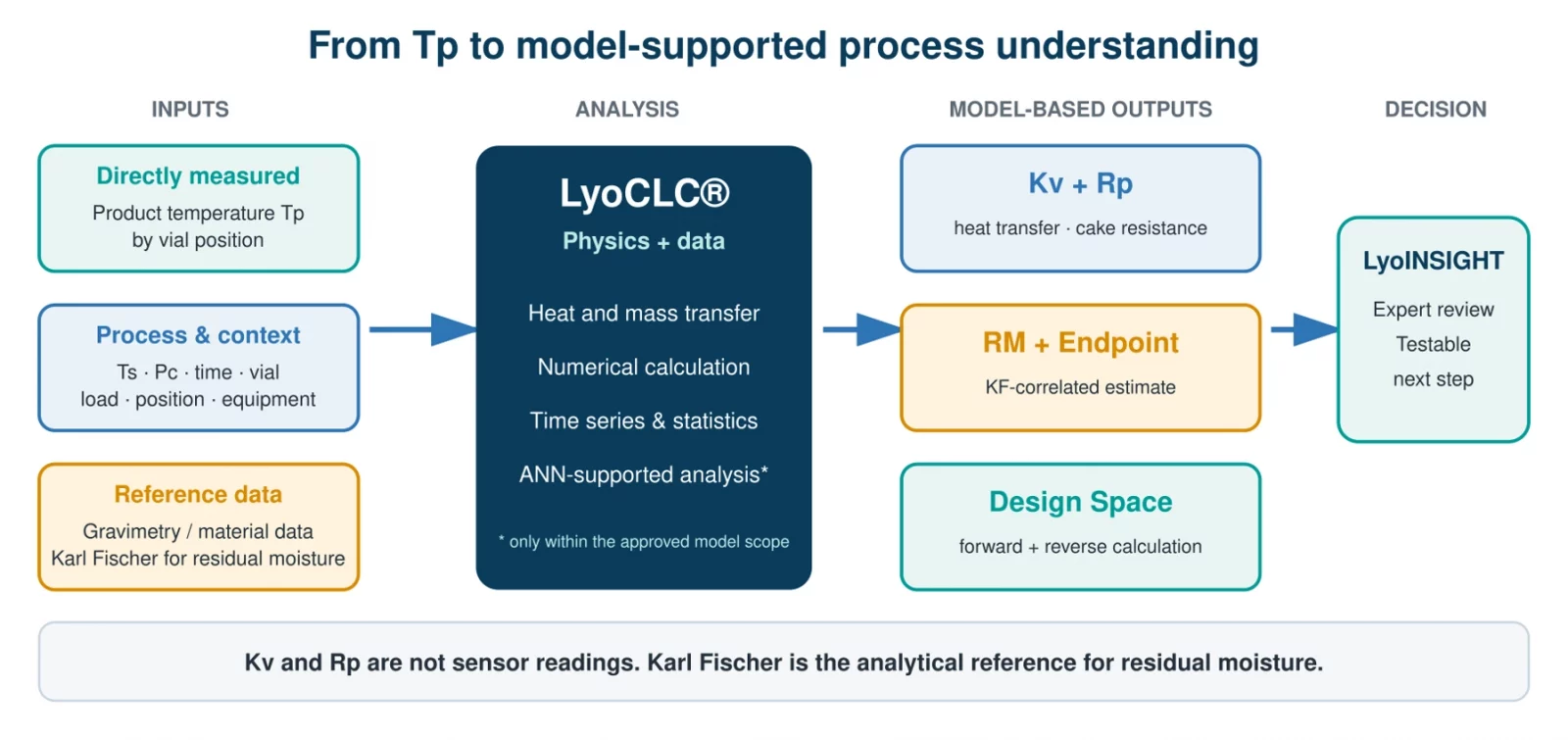
For technical traceability, the Tempris Evidence Architecture separates Understanding into Contextualize and Analyze. This keeps the chain visible from the directly measured product response to the expert-reviewed next step.
Methodical Transparency
Tp is measured directly at instrumented positions. Kv and Rp are assessed using additional process, geometry, and mass-transfer inputs, and, where applicable, gravimetric inputs. Karl Fischer titration provides a direct analytical reference for residual moisture; LyoCLC® can correlate these references with Tp and process profiles and, within a qualified model, support residual moisture estimation. Endpoint indicators, design-space scenarios, and residual-moisture relationships are calculated, modeled, or correlated outputs. Final decisions on process, quality, validation, and release remain with the pharmaceutical manufacturer and its responsible functions.
The Guided LyoINSIGHT Project Pathway
The project methodology outlines how a specific customer question is addressed. It complements the four-stage Evidence Architecture but does not replace it.
- 1Understand
Jointly define the technical and business process question, the intended decision, product limits, and the responsible stakeholders. - 2Structure
Document the assessment design, required data, roles, assumptions, acceptance criteria, and Data Readiness Gate. - 3Measure
Define a measurement strategy aligned with the project objective for selected vial positions, loading zones, and process phases. The number of measurement positions depends on the objective, equipment scale, load configuration, and expected variability. - 4Baseline
Capture an appropriate reference or a conservative baseline run using actual product-temperature and process data before evaluating advanced models and scenarios. - 5Calculate
Apply physics-based heat- and mass-transfer models and numerical calculations for Kv and Rp. Time-series comparisons, statistics, and, where approved, ANN-supported analyses support endpoint, variability, KF-correlated residual-moisture relationships, and other project-specific outputs. - 6Simulate
Forward design-space scenarios assess the expected product response under defined process conditions. Reverse Calculation starts from the target Tp or defined product limits and evaluates suitable combinations of shelf temperature, chamber pressure, and process time. A testable hypothesis for the next run is derived from the result. - 7Decide
Jointly review results, assumptions, uncertainties, and limitations; document a technically justified recommendation; and define the next step in engineering, transfer, or confirmation.
Technical Detail
Forward Design Space assesses expected product responses under defined process conditions and documented assumptions. Reverse Calculation starts with a target product temperature or defined product limits and evaluates suitable combinations of shelf temperature, chamber pressure, and process time. Both approaches build on actual baseline data and product, process, and equipment knowledge. They narrow the scenarios before the next run and support a Right-First-Time-oriented development approach; the resulting process hypothesis is then verified in a focused run.
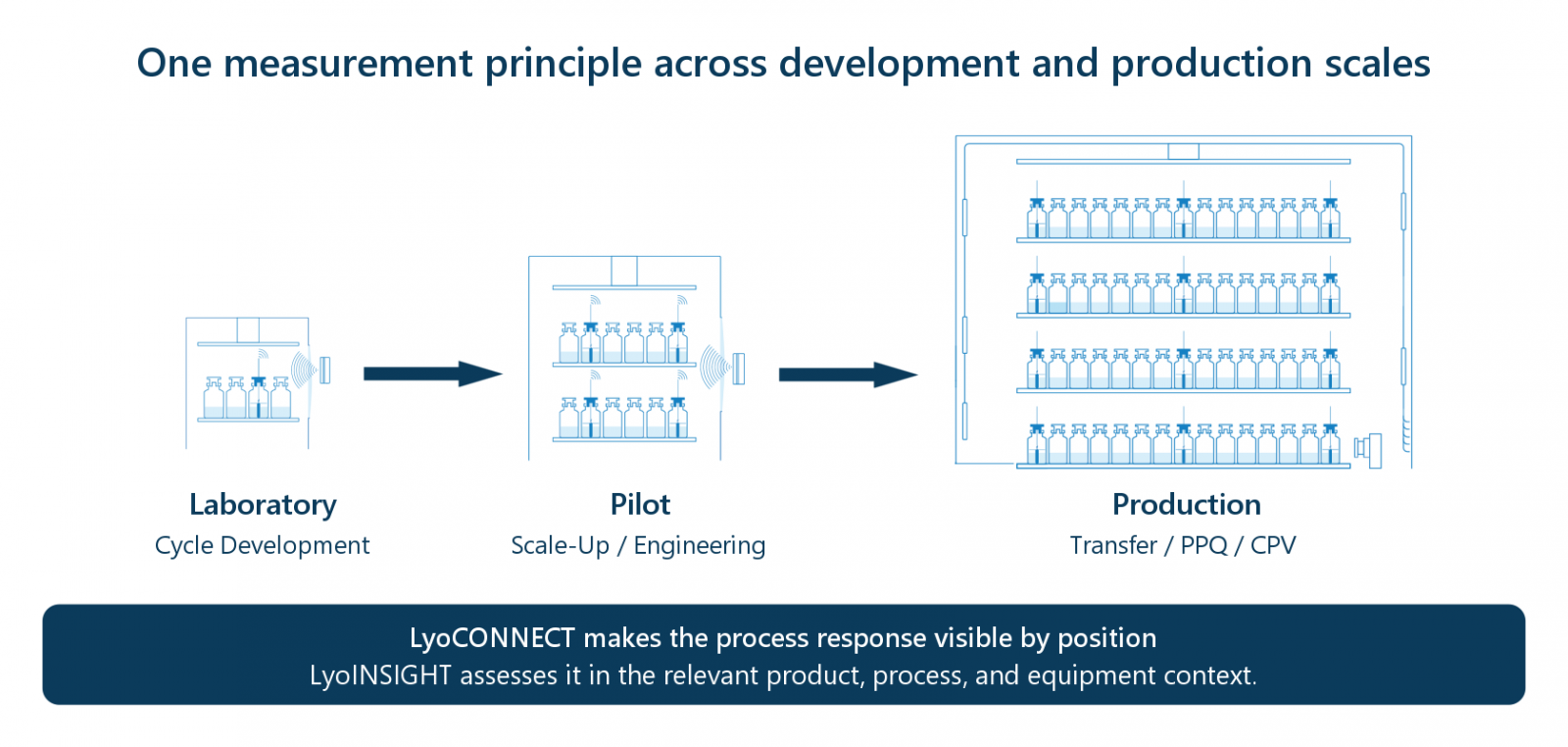
LyoCONNECT uses the same principle of direct Tp measurement from laboratory through pilot to production scale. LyoINSIGHT compares measured product response within its product, loading, process, and equipment context, and across freeze dryers or sites. Depending on the project scope, the assessment covers temperature profiles, spatial distribution, hot/cold/slow-drying positions, shelf temperature and pressure profiles, equipment context, model-supported Kv/Rp and endpoint outputs, and available CQA and analytical references. Assumptions, data gaps, and uncertainty are documented. The result supports the next engineering, transfer, or PPQ step; it does not, by itself, demonstrate comparability or regulatory equivalence.
When a batch deviates from expectation or reference, LyoINSIGHT reconstructs the measured product response and relates it to position, loading, recipe, process phase, and equipment state. The comparison may include product-temperature profiles, Kv/Rp/endpoint and variability outputs, available laboratory or Karl Fischer references, and historical or approved comparison batches. Causal hypotheses are documented with supporting, contradictory, and missing evidence, and a next verification run or assessment step is proposed. The formal QMS investigation, root-cause determination, CAPA approval, and batch disposition remain with the manufacturer.
What You Receive from a LyoINSIGHT Project
The exact scope is defined for each project. The result is not another isolated data set but a structured, expert-reviewed basis for action. It is intended to reduce manual consolidation, enable more purposeful preparation of engineering runs, and shorten the path from the process question to the next verification step. A typical LyoINSIGHT project may deliver:
Regulatory Boundary
Decision Support with Clear Accountability Boundaries
LyoINSIGHT provides expert-reviewed decision support. Final decisions on process, quality, validation, and release remain with the pharmaceutical manufacturer and its responsible functions.
LyoINSIGHT does not replace Karl Fischer titration, validated analytics, release testing, required engineering or PPQ activities, site-specific computerized-system validation, or accountable expert assessment. Intended use, data integrity, validation scope, and regulatory relevance must be defined for the specific product, process, system, and site. For Deviation Support, LyoINSIGHT does not replace the formal QMS investigation or approval of root cause, CAPA, or batch disposition.
Frequently Asked Questions
LyoCONNECT measures product temperatures at selected vial positions. The Tempris Digital Twin provides spatial and process context. LyoCLC® analyzes and models relevant relationships. LyoINSIGHT and expert review support project-specific interpretation and the next step.
The requirements follow from the process question. Typical inputs include LyoCONNECT temperature profiles, sensor positions, shelf temperature, chamber pressure, vial and fill information, load configuration, equipment context, product limits, and available analytical references.
Yes. Tempris can first structure the process question, data readiness, and measurement strategy for a planned reference or baseline run. If suitable existing data are available, they are first assessed for usability and gaps.
No. LyoINSIGHT supports interpretation and preparation of well-founded next steps. Model outputs are reviewed by experts together with process and analytical evidence. Validated analytics, release testing, and accountable decisions remain unchanged.
LyoINSIGHT structures the available evidence, reconstructs the measured product response, compares it with suitable references, and documents causal hypotheses, data gaps, and the recommended next assessment step. The formal investigation, root-cause determination, CAPA, and batch disposition remain within the manufacturer’s quality system and accountable functions.
A Challenge That Drives Us
Tempris developed LyoINSIGHT because the full value of product-temperature measurement can only be realized when measurement data, process context, models, and expertise are brought together to create a traceable understanding of the process.
We are proud to offer a structured solution for this demanding task. We look forward to working with our customers to explore how LyoINSIGHT can support their specific process question.