
LyoCONNECT
LyoCONNECT – Produkttemperaturen im Gefriertrockner sichtbar machen
Messen Sie die Temperatur direkt im Produkt und erkennen Sie Unterschiede zwischen ausgewählten Positionen Ihrer Beladung. LyoCONNECT verbindet die Messwerte mit den Prozessdaten. Die Tempris-Software TLM-3D bildet die Gefriertrocknungskammer mit allen Stellflächen als digitalen Zwilling ab und zeigt die räumlichen Temperaturverläufe an den jeweiligen Messpositionen.
So können Ihre Teams beurteilen, ob die Produkttemperatur an den Messpositionen innerhalb der wissenschaftlich begründeten, für das Produkt festgelegten Temperaturgrenzen bleibt. Das unterstützt eine Prozessführung, die die qualitätsrelevanten Eigenschaften des Arzneimittels schützt.
What happens to the product during freeze-drying?
The drying program specifies the shelf temperature and chamber pressure. However, the actual product temperature results from the interplay of heat input and drying: heat is transferred via contact with the shelf surface and through thermal radiation from the environment to the vial, and via the vial’s bottom and side walls to the product. At the same time, ice sublimation requires energy. The already-dried product layer increasingly hinders water vapor escape.
Therefore, the product temperature can differ significantly from the surface temperature, especially during primary drying. Because heat input and contact conditions vary by vial position, drying rates also vary within the same load.
LyoCONNECT makes the temperature differences at the measured positions visible
Each temperature profile is assigned to the corresponding sensor, its position, and the process run. The digital twin’s spatial representation helps your teams identify position-specific differences and assess them alongside freeze-dryer conditions.
This provides a comprehensive data foundation for evaluating the product’s temperature profile, comparing process runs, and making informed decisions for development, scale-up, and technology transfer.
LyoCONNECT for all Lyo Scales
Die kabellose, batterielose Tempris-Sensortechnologie gewährleistet eine Echtzeit-Produkttemperaturmessung in allen Lyo-Skalierungen – vom Labor bis zur Produktion werden die gleichen Tempris-Sensoren verwendet, um direkt vergleichbare Daten zu erhalten. Start with the lyophilization cycle development in a laboratory freeze-dryer, scale-up und transfer to pilot freeze-dryers and then go into production of your approved product and get comparable data about the product temperature during lyophilization over the whole process.
Ganz gleich, ob Sie für Ihre Produkte Fläschchen, Schalen, Zweikammerspritzen oder andere Primärverpackungen verwenden, Tempris-Sensoren können mit allen verwendet werden.
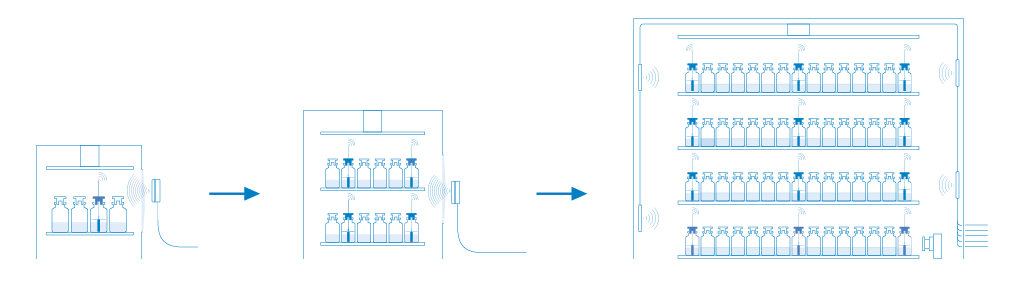
Laboratory Freeze-Dryer
Lab Scale Development
Typical Shelf Size:
1 to 5 ft2 / 0.1 to 0.5 m2
Lyophilization cycle development in the laboratory establishes the base for the freeze-drying cycle and its subsequent optimization. Tempris captures the product temperature (Tp) at the vial bottom (Tb), one of the most critical lyo-cycle parameters. In the TLM software, you can monitor the product temperature in real-time.
Pilot Freeze-Dryer
Clinical Manufacturing
Typical Shelf Size:
10 to 50 ft2 / 1 to 5 m2
Your product moves to a larger freeze-dryer, to a different type of freeze-dryer or simply to cGMP environment. Tempris allows the same sensors to be used in lab, pilot, and production scale freeze-dryers, providing directly comparable data. This eliminates problems with changing Tp measurement technology and positioning of RTDs in sterile environments. Tempris sensors can be used to bridge from laboratory-scale and for future bridging to production scale.
Production Freeze-Dryer
Commercial Manufacturing
Typical Shelf Size:
100 to 500 ft2 / 10 to 50 m2
Production lyophilizers can reach huge proportions, and at this scale the stakes are very high indeed. Tempris wireless, battery-free temperature sensors are used by some for every cGMP batch for commercial use. This trend is growing because the Tempris data provides assurance of product quality, gives regulatory flexibility, and enables easier process optimizations.